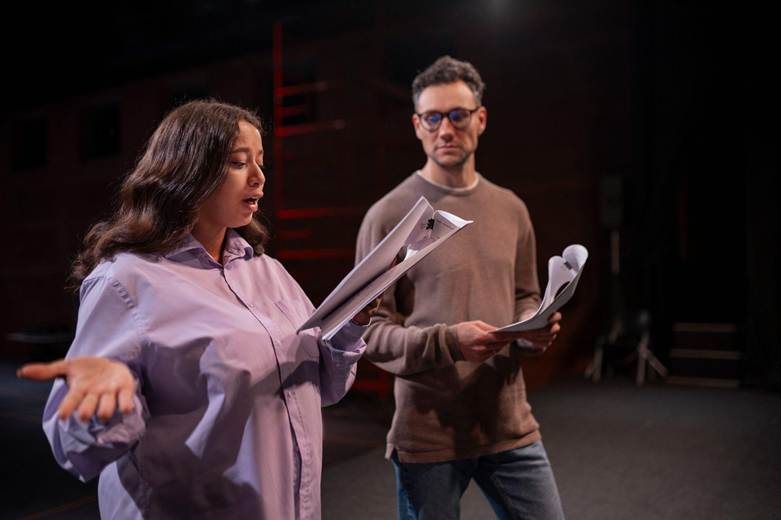
The words on the page may remain unchanged, but a live performance never happens the same way twice. Michelle Suzanne Huff explains that actors, audiences, timing, staging, and countless small variations can make each night at the theater feel distinct.
That unpredictability is part of what separates live theater from watching a recorded movie or television show. The story may be familiar, yet everyone in the room is experiencing one particular performance that cannot be perfectly recreated.
The Script Provides a Foundation, Not an Identical Result
A script establishes dialogue, characters, scenes, and stage directions, but it does not control every detail of a performance.
Actors still have to interpret the material in real time.
A pause’s length can shift a scene’s mood. A subtle shift in emphasis can make a line sound funnier, sadder, or more serious. Facial expressions and physical movements can also vary slightly without changing the basic production.
These differences may be almost impossible to notice from one evening to another.
Collectively, however, they help explain why live theater never feels completely mechanical.
The performers are repeating a production, not replaying a recording.
Audience Reactions Become Part of the Performance
An audience does more than quietly observe what happens onstage.
Its reactions influence the atmosphere inside the theater.
One crowd may laugh immediately at a particular line. Another may remain quiet for an extra moment before responding. A dramatic scene can create complete silence one evening and audible reactions the next.
Performers are aware of that energy.
Comedy provides an obvious example. Actors may need to leave enough room for laughter before continuing so the next line can be heard. When a joke produces a larger response than expected, the rhythm of the scene naturally changes.
The audience therefore becomes part of the timing even though nobody in the seats appears in the script.
Timing Can Transform Familiar Dialogue
Good theater depends heavily on timing.
Two actors can deliver exactly the same dialogue with slightly different pacing and create different impressions.
A quick response might communicate confidence or irritation. A longer pause can suggest uncertainty, tension, surprise, or reflection.
Timing also affects larger parts of the production.
Scene transitions may feel particularly smooth one evening. A musical cue may feel perfectly timed. An emotional sequence might develop with unusual intensity because the pace feels especially natural.
These differences demonstrate why knowing the words does not mean knowing exactly how a scene will feel.
Actors Bring Human Variation to Every Performance
Live performers are not the same every day.
Energy levels change. Concentration changes. The connection between cast members may feel particularly strong during one performance. Small adjustments made over the course of a production can also influence later shows.
Professional performers work to provide consistency, but consistency is different from perfect duplication.
That human element creates part of theater’s appeal.
A movie preserves one selected version of a performance after scenes have potentially been filmed multiple times. Theater asks performers to create the entire experience again in front of an audience.
There is no opportunity to rewind the evening and replace a moment with another take.
Where You Sit Can Change What You Notice
The same production can even feel different depending on where someone sits.
From farther back, a viewer may appreciate the complete stage picture. Sets, lighting, choreography, and movement can be easier to understand as a whole.
Closer seats provide another perspective.
Facial expressions, costumes, and subtle physical interactions may become more noticeable. Details that seemed minor from the rear of the theater can suddenly attract attention.
Sitting toward one side may also reveal different aspects of staging than sitting near the center.
This means someone could attend the same production twice and discover details simply by viewing it from another part of the room.
Sets and Lighting Do More Than Create a Background
Live theater is also a physical visual experience.
Sets establish the environment, but their effect can change as actors move through them and lighting transforms the stage.
A single set may look warm and inviting during one scene and unsettling during another because of changes in color, shadow, or intensity.
Transitions are part of the experience too.
Watching one location become another in seconds reminds the audience that the environment is being created directly in front of them.
Unlike film, theater cannot rely on cutting instantly to a completely different location. Productions must solve those transitions within the physical limitations of the stage.
Those solutions can become memorable parts of the show.
Small Unexpected Moments Are Part of Live Performance
Not every variation is intentional.
A prop may behave slightly differently. A costume adjustment might take an extra second. A performer could respond to an unexpected sound from the audience or something occurring elsewhere onstage.
Most of these moments are minor and may pass unnoticed.
Yet they reinforce something fundamental about live theater: everyone is sharing an event happening in real time.
The possibility of variation creates a subtle sense of immediacy.
Nothing needs to go wrong for that feeling to exist. Simply knowing that the performance is unfolding rather than being replayed changes how it is experienced.
Seeing the Same Production Twice Can Reveal More
People sometimes assume there is little reason to see a play again after knowing the story.
A second viewing can actually shift attention.
During the first performance, much of the focus may be on following the plot. Once the story is familiar, there is more opportunity to notice other elements.
A returning viewer might pay greater attention to:
- Background performances
- Costume details
- Lighting transitions
- Changes in scenery
- Foreshadowing in earlier scenes
- Physical reactions between characters
- Music and sound design
- Details that become meaningful later
Knowing what happens can make the construction of the production easier to appreciate.
Live Theater Requires a Different Kind of Attention
Recorded entertainment gives viewers considerable control.
A movie can be paused. A television episode can be stopped while someone checks a phone. A missed line can be replayed.
Theater keeps moving.
That creates a different relationship with attention.
Once the performance begins, the audience follows the pace established onstage. A moment that passes is gone, and the next one has already started.
This can make watching feel more deliberate.
For a few hours, everyone in the room agrees to follow the same story at the same speed.
The Shared Experience Matters
Hundreds or even thousands of people can watch the same film separately and receive nearly identical recorded content.
A theater audience shares one particular evening.
The laughter belongs to that crowd. The quiet belongs to that crowd. The performers respond to the atmosphere created in that room.
When the curtain falls, that exact combination of performers, audience reactions, timing, and small variations is finished.
The next performance may follow the same script and staging, but it will involve a different group of people experiencing it together.
Final Thoughts
Live theater does not need a changing script to create a different experience each night.
Actors bring natural variation to their performances. Audiences influence timing and atmosphere. Seating changes perspective, while lighting, scenery, sound, and subtle details provide more to notice than the dialogue alone.
Even seeing the same production twice can reveal elements that were overlooked the first time.
That is part of what makes theater distinctive.
A recorded performance can be replayed exactly. A live one exists for a particular audience at a particular moment.
The script may tell everyone what is supposed to happen, but the experience of watching it happen belongs only to that night.